At the All Nite Soul Review
Judith, 52,
Dances along to songs
She always knew
The acts upon the stage
Some are showing their age
The Classic, the Original and the New
Before them glittering ranks
Applaud their sweaty thanks
Their tits swinging lower than they ever used to do
Fulled by cheap warm wine
They're having a fine old time
Forgetting the miserable lives for an hour or two
With the girls they can forget
Every mistake they've met since 1962
Their eyes sparkle at the drummer in
The Classic, the Original and the New
Vicious spiteful words
I feel ashamed and absurd
They're only saving themselves like we all do
The Classic, the Original and the New
May not sparkle like they used to do
May not even be able to stand
May not be the ones they used to be
But Ladies and Gentleman, just for you
And Judith, 52,
Tonight I give to you Direct from 1972
The All Nite Soul Review
Wednesday, March 26, 2014

Different scales
James Ward has posted some pictures of Airfix kits of bombed, shelled or otherwise damaged buildings. The Italian farmhouse looks like the kind of project you would see on Grand Designs, or similar, although they would inevitably ruin it, and by the end of the programme you would be keen to throw a few shells at it yourself.
But the thing that really intrigued me was the difference in scale. Some of the buildings are 1:72, but most are 1:76. I remember all Airfix kits being 1:72 – at least those of roughly that size. There were larger and smaller scales, which from memory were 1:144, 1:32 and 1:24, but 1:72 was the most frequent one. So why would they introduce 1:76? Surely there is not that much difference between the two. Surely it does not matter.
It turns out it matters a lot.
But the thing that really intrigued me was the difference in scale. Some of the buildings are 1:72, but most are 1:76. I remember all Airfix kits being 1:72 – at least those of roughly that size. There were larger and smaller scales, which from memory were 1:144, 1:32 and 1:24, but 1:72 was the most frequent one. So why would they introduce 1:76? Surely there is not that much difference between the two. Surely it does not matter.
It turns out it matters a lot.
Thursday, March 06, 2014
Lost in translation
Wikipedia's "Did you know?" for today features this slightly puzzling entry.

In China, Lou is both the 229th, and 269th, most common surname. Of course the answer is that two different Chinese surnames have been translated into the same English word.
In China, Lou is both the 229th, and 269th, most common surname. Of course the answer is that two different Chinese surnames have been translated into the same English word.
Thursday, February 13, 2014
Ullage
In the Daily Telegraph, Helen Yemm has her jobs of the week. She includes this task
My question is, "what is ullage?" The OED defines it as
Clear emerging perennial shoots of old wet leaves and winter ullage – to make it easier to see what is going on and get the upper hand in the slug war.
My question is, "what is ullage?" The OED defines it as
The amount of wine or other liquor by which a cask or bottle falls short of being quite full (originally the quantity required to make good the loss by leakage or absorption).
There are some vaguely colloquial usages, but nothing that really matches "the soggy stuff that collects around plants over winter". My guess is that it is a typo for "foliage", although I'm not entirely convinced that's right. Either way, it's a great word, and the next time I have a bottle of wine I will point at the air at the top of the bottle and say, "Wow! Look at the ullage on that!"
Wednesday, January 22, 2014
Creading
There are many words in use in academia that I don't understand - palimpsest, for one. When I came across the description of this symposium, therefore, the word "creadings" jumped out at me:
I looked it up in the OED and, naturally, it wasn't there. It isn't a word that crops up in a Google search either. It is, after all, a typo.
Chanting Students
Dr. Matthew Cheeseman
I began researching and collecting examples of student chanting in 2005 and have found them a stimulating way of thinking about students and their experience of higher education. Far from simple, chants are both verbal forms and performances, full of contradictory meanings and creadings. In this paper I look at how they are received by others and how they operate as expressions of student identity and enactments of 'lad culture'. Using data collected following an ethnographic methodology, I attempt to situate chanting within larger and no less contradictory performances (such as being a student) and explain its relationship to a language that has become a totemic within the United Kingdom: banter.Rather than assume that "creadings" was a typo for "readings", I supposed that it must be a new word coined in academia. (I have no idea what "a totemic" is either, but that's beside the point). I assumed that a "creading" would be something like a cross between a reading and a creed. It would be a way of analysing that involved reading whatever you were reading while looking for evidence that it might be connected to some kind of belief system. It sounds logical to me.
I looked it up in the OED and, naturally, it wasn't there. It isn't a word that crops up in a Google search either. It is, after all, a typo.
Monday, January 13, 2014
Black book
I increasingly find that I have strong opinions about people, but I have very little idea why. When I look at the people who are in the various categories, they don't seem to have anything in common. When I try to look at it objectively, there is no particular reason why I should find one likeable and another hideous. I don't understand it.
James Corden
Dermot O'Leary
Gareth Malone
Kirstie Allsopp
Evan Davis
Chris Evans
Brian Matthews
Susannah Reid
Alex Jones
Carol Kirkwood
Graham Norton
Jamie Oliver
Bill Turnbull
Can't stand
Clare BaldingJames Corden
Dermot O'Leary
Gareth Malone
Kirstie Allsopp
Can put up with
Tony BlackburnEvan Davis
Chris Evans
Brian Matthews
Susannah Reid
Like
Mishal HusainAlex Jones
Carol Kirkwood
Graham Norton
Jamie Oliver
Bill Turnbull
Thursday, January 09, 2014
Similarities
Watching the news this morning, I was struck by the resemblance between Tom Cruise and Thomas Hitzlsperger. I wonder if they could be related?
 |  |
| Cruise | Hitzlsperger |
Friday, December 20, 2013
Data is, um, are, datum is, oh boy!
I think that the battle over keeping datum singular and data plural has been lost. However, many would disagree. This recent press release from the University of British Columbia wants data to be plural, but in this section... well, I'm not quite sure what is going on.
“Publicly funded science generates an extraordinary amount of data each year,” says Tim Vines, a visiting scholar at the University of British Columbia. “Much of these data are unique to a time and place, and is thus irreplaceable, and many other datasets are expensive to regenerate.I suspect that the quote from Vines started with data being singular - "Much of this data" etc - but that someone changed bits of it into the plural. How "Much of this data are" can be correct with "is irreplacable" escapes me. The second paragraph has a similar confusion.
“The current system of leaving data with authors means that almost all of it is lost over time, unavailable for validation of the original results or to use for entirely new purposes.”
Peak time
Still on the subject of time, in a recent edition of the Infinite Monkey Cage, I was surprised to hear Professor Brian Cox say "counter-clockwise", since I had taken it to be a term from US English. I assumed that it was because he must have spent no little time in the US, and presumably reads a lot of US literature. When I looked at the relative frequencies of "counter-clockwise" and "anti-clockwise" in the Google ngram viewer, I noticed something surprising:
Here's the chart for UK English - a closer battle than I would have expected, but with anti-clockwise just keeping a lead. However, there is a distinct peak in the 1940s, since when the use of both terms has been on the decline.

The peak is even more pronounced in American English. Counter-clockwise wins comfortably, but since 1940 has been in decline.

Why should this be? Perhaps as more stuff has been displayed digitally, and we are less in touch with making and repairing things by hand, the words for rotating something one way or the other are falling out of fashion.
This seems to be supported by a search for "clockwise", which is suffering a similar, if less marked, decline:
Finally, although I won't include the graphs, mentions of the pre-clock words "sunwise" (ie, clockwise) and particularly "widdershins" (ie, anti-clockwise) have tended to grow over the same period. I have no idea why.
Here's the chart for UK English - a closer battle than I would have expected, but with anti-clockwise just keeping a lead. However, there is a distinct peak in the 1940s, since when the use of both terms has been on the decline.

The peak is even more pronounced in American English. Counter-clockwise wins comfortably, but since 1940 has been in decline.

Why should this be? Perhaps as more stuff has been displayed digitally, and we are less in touch with making and repairing things by hand, the words for rotating something one way or the other are falling out of fashion.
This seems to be supported by a search for "clockwise", which is suffering a similar, if less marked, decline:
 |
| American English |
 |
| British English |
Finally, although I won't include the graphs, mentions of the pre-clock words "sunwise" (ie, clockwise) and particularly "widdershins" (ie, anti-clockwise) have tended to grow over the same period. I have no idea why.
Friday, December 13, 2013
The time seller
The Oxford Dictionary of National Biography does a regular podcast, which every fortnight, as well as the famous, covers more obscure British lives.
The latest edition featured Ruth Belville, also know as the Greenwich Time Lady, who sold time. Although chronometers were becoming increasingly accurate, their makers were desperate to know the correct time, but had no way of finding it out. They used to go up to Greenwich Observatory to find out what it was, but the Astronomer Royal, Sir George Biddell Airy, got fed up of them interrupting work, and asked his deputy, John Henry Belville, to set up the time selling service. The business became a family affair, run by John Henry, then his widow, then his daughter Ruth.
Incredibly, it continued for more than 100 years, only ending in 1940 when Ruth was 86 and her age, and the effects of World War II, finally forced her to retire. I love finding these hidden corners of life.
The latest edition featured Ruth Belville, also know as the Greenwich Time Lady, who sold time. Although chronometers were becoming increasingly accurate, their makers were desperate to know the correct time, but had no way of finding it out. They used to go up to Greenwich Observatory to find out what it was, but the Astronomer Royal, Sir George Biddell Airy, got fed up of them interrupting work, and asked his deputy, John Henry Belville, to set up the time selling service. The business became a family affair, run by John Henry, then his widow, then his daughter Ruth.
Incredibly, it continued for more than 100 years, only ending in 1940 when Ruth was 86 and her age, and the effects of World War II, finally forced her to retire. I love finding these hidden corners of life.
Thursday, December 12, 2013
Don't sell dishwashers in Shanghai
If you are considering setting up a business to sell dishwashers in Shanghai, think again. The latest PISA results show that children living in Shanghai, and who have a dishwasher in their home, do worse on their reading scores than their peers.
This bucks the trend for the rest of the OECD countries covered by the report. Everywhere else, if you have a dishwasher at home your reading scores will be higher.
Given the enthusiasm for education in Shanghai, it seems unlikely that you would be able to make a success of a dishwasher business (unless your market is people who don't have, and don't want, kids). So, basically, set up your business somewhere else. You're welcome.
 If you want a serious explanation, I suggest that in the UK and elsewhere homes with dishwashers are likely to be those of reasonably well-off people, whose children will be better at reading. The difference in Singapore is small (although it is still there, even with error bars). Maybe they are so rich that they have servants who do the dishwashing, so the people with dishwashers are actually poorer than the rest. I don't care, I just like the fact that data can show stupid things.
This bucks the trend for the rest of the OECD countries covered by the report. Everywhere else, if you have a dishwasher at home your reading scores will be higher.
Given the enthusiasm for education in Shanghai, it seems unlikely that you would be able to make a success of a dishwasher business (unless your market is people who don't have, and don't want, kids). So, basically, set up your business somewhere else. You're welcome.

Christmas morning
Greg Lake's song, I Believe in Father Christmas, is one that I don't particularly care for, but it is difficult to avoid at this time of year. It contains this slightly odd verse.
And I believed in Father Christmas And I looked to the sky with excited eyes Then I woke with a yawn In the first light of dawn And I saw him and through his disguiseThis morning the first light of dawn was about 7.30am, and that was outside on a reasonably clear day. In a bedroom with curtains, I would think it would come a bit later. Sunrise on Christmas Day is 8.05am in London, and later in the North. So my questions are:
- What sort of child wakes up as late as 7.30am on Christmas morning (even though he was up late watching the sky with excited eyes)?
- What sort of Father Christmas is still putting out the presents at 7.30am?
Tuesday, December 10, 2013
Is it spam or just really bad marketing?
A series of emails have been arriving that I assume are spam. The thing is, they are a bit different.
Firstly, they are mostly promoting reputable companies, such as Laithwaite's, Ladbrokes, The Sun, NatWest, Anglian Home Improvements, and Match.com. OK, there is some PPI/debt management nonsense, but most of it seems fairly respectable.
Secondly, the offers are all fairly dull. They don't offer miracle cures for personal problems, or pretend that you have won the lottery – they are simply dull things like 0% on balance transfers, or a £10 Tesco voucher for taking out a subscription.
One offer arrived recently for The Sun – ", join Sun+ today for a 10 Tesco voucher" was the subject, so the weird punctuation makes you wonder if something is not quite right (a lot of them seem to have that rogue comma at the beginning). The Sun does make that offer
 so that seems genuine. Picking sample phrases and googling them (such as the terms and conditions) finds similar copy on The Sun's website. But there are a couple of very odd things that make me suspicious.
Firstly, the websites used for the links are different in each email and are bizarre, although also, frankly, quite funny – teensy neutrinos, prominences penny frog, council absent jester, mellow connotation, and so on.
Secondly, they all come with an address in Florida at the bottom – 7862 W. Irlo Bronson Highway Suite #313 Kissimmee, FL 34747, which seems to be associated with a company that owns at least 500 domains.
And at that point, my interest begins to fade. Except to wonder what the business model is. Is it to make spam that is almost identical to the boring and dull messages we get from regular companies? In the past spammers have concentrated on exciting, sexy or alarming messages, but now they realise that we are suspicious of those, they're copying the dull marketing messages of normal companies, which do work, after all. I'm guessing that, unfortunately, it will also make them harder to spot. As I've written before, though, if spammers got their grammar sorted out, then we would be in real trouble.
Firstly, they are mostly promoting reputable companies, such as Laithwaite's, Ladbrokes, The Sun, NatWest, Anglian Home Improvements, and Match.com. OK, there is some PPI/debt management nonsense, but most of it seems fairly respectable.
Secondly, the offers are all fairly dull. They don't offer miracle cures for personal problems, or pretend that you have won the lottery – they are simply dull things like 0% on balance transfers, or a £10 Tesco voucher for taking out a subscription.
One offer arrived recently for The Sun – ", join Sun+ today for a 10 Tesco voucher" was the subject, so the weird punctuation makes you wonder if something is not quite right (a lot of them seem to have that rogue comma at the beginning). The Sun does make that offer

Firstly, the websites used for the links are different in each email and are bizarre, although also, frankly, quite funny – teensy neutrinos, prominences penny frog, council absent jester, mellow connotation, and so on.
Secondly, they all come with an address in Florida at the bottom – 7862 W. Irlo Bronson Highway Suite #313 Kissimmee, FL 34747, which seems to be associated with a company that owns at least 500 domains.
And at that point, my interest begins to fade. Except to wonder what the business model is. Is it to make spam that is almost identical to the boring and dull messages we get from regular companies? In the past spammers have concentrated on exciting, sexy or alarming messages, but now they realise that we are suspicious of those, they're copying the dull marketing messages of normal companies, which do work, after all. I'm guessing that, unfortunately, it will also make them harder to spot. As I've written before, though, if spammers got their grammar sorted out, then we would be in real trouble.
Wednesday, December 04, 2013
CON - Artists
I don't know if this proposal for the Intellectual Property Office's 2013 Fast Forward Competition was real or a piece of performance art (ie, the proposal was a piece of performance art, as opposed to the show they were proposing). Either way, unfortunately it didn't get funded.
CON - Artists [Copyright Owners Network - Artists]
This Coventry School of Art and Design show delivers an entertaining look at the complex world of copyright, taking a look at its early conception, through to the rapidly changing digital world encountered today. The outcome will be a UK business and academic sector well informed of the importance of copyright in the global economy, and to face the issues head on.
The audience will be left with an understanding of the duration, scope, limitations, economic and moral rights associated with this unregistered form of IP and its importance to our economy. It is designed for this generation, born into a global information rich society, where click copying is a way of life. Copyright will be seen throughout [sic] this kaleidoscope of dance, music, literature, film, photography and mime, made by our creative industry, for the entire nation.
Monday, December 02, 2013
Nasty road accident
Upset by this accident I saw on the way to work – a multi-pack of Twix had been run over. Difficult to say from the mangled wreckage what had happened, but it looks like at least a pack of nine, and possibly as many as 12. Tragic loss.


Friday, November 29, 2013
Dirocev, what's a dirocev?

Monday, November 25, 2013
Mealtimes
A quick guide to the timetable of mealtimes:
Midnight–5am Late-night snack
5am–10am Breakfast
10am–noon Elevenses or, if more substantial, brunch
Noon–2pm Dinner (or lunch)
2pm–4.30pm Afternoon (or high) tea
4.30pm–8.30pm Tea (or dinner)
8.30pm–11pm Supper
11pm–Midnight Late-night snack
Midnight–5am Late-night snack
5am–10am Breakfast
10am–noon Elevenses or, if more substantial, brunch
Noon–2pm Dinner (or lunch)
2pm–4.30pm Afternoon (or high) tea
4.30pm–8.30pm Tea (or dinner)
8.30pm–11pm Supper
11pm–Midnight Late-night snack
Saturday, November 23, 2013
The Day of the Doctor
I am not sure that I quite understood the Doctor Who episode The Day of the Doctor. However, here is what I think happened:
After the Doctor Who TV movie of 1996, which failed to re-ignite the series, the Eighth Doctor (played by Paul McGann) got really angry, and turned into the Ninth Doctor (played by John Hurt). Upset by the cancellation of the series, he rampaged through the old sets, destroying the Daleks, Gallifrey and the Time Lords. At the time, this seemed like a reasonable thing to do, but everyone decided this was something we should never speak of again.
Surprisingly, a few years later Russell T Davies managed to revive the series, with Christopher Eccleston playing the Ninth Doctor. It was a huge hit, and everyone was very happy. But the problem remained of what to say about the fact that there were no Daleks or Time Lords left. Well, thankfully, a few Daleks were found in an old warehouse, or possibly a gravel pit near Slough, and, after a bit of a redesign to make them suitable for merchandising purposes, they were brought back into the series.
The Time Lords were still missing, though, so the Tenth (David Tennant) and Eleventh (Matt Smith) Doctors had to go back in time to convince John Hurt of a couple of things. Firstly, that he no longer needed to go on a rampage and destroy the Daleks and the Time Lords. The series is a huge hit again; everyone loves it. Secondly, that he will never be the Ninth Doctor, and that title is to be kept by Paul McGann. He will have to accept the title of War Doctor (I think Angry Doctor would have been better, but it is not my call). Gallifrey will be frozen in time until it is needed in the next series, when the sweary Twelfth Doctor (Peter Capaldi) can be sent to look for it.
I may have got some of the finer detail wrong, but I think this is pretty much it.
Friday, November 15, 2013
Movember spawned a monster
I have never taken much interest in awareness campaigns. That I began taking part in the latest Movember was largely by chance. My daughter kept getting into the bathroom before me and steaming up the mirror, so I developed an increasingly unshaven look. Then my son suggested that I take part in Movember, like his friend's dad, and I agreed, you know, for fun. It was a mistake for two reasons.
Firstly, my face is unsuited to a moustache. I had envisaged something dashing, like Robert Donat in The 39 Steps, but I do not have the time, and probably the face, to create that look. It does make me wonder how he managed to keep his moustache in trim while roughing it in the Highlands, but that is another story. I ended up looking more like Magnum PI or a member of the Village People. I found this disturbing, not only at the purely superficial level, but also as a reflection of who I am. I have not had time to consider this in detail.
Secondly, it introduced me to the disappointing worth of the Movember campaign. Medical colleagues told me that prostate cancer is overdiagnosed and overtreated and, perhaps because of the success of Movember, arguably overfunded. As this comment on a Guardian piece about Britain's top 1000 charities put it:
I think the issue here is probably the way that the media, and particularly social media, discourage sensible debate, and encourage a sort of frantic national consensus – something that has also been apparent in the latest Remembrance Day – or Remembrance Weekend as it is now being described (Remembrance Week/Month coming soon).
This story in the Daily Telegraph – Google criticised for 'demeaning' tribute to Britain's war dead – highlighted the issues neatly. There had apparently been criticism of Google's decision to put a subtle poppy on its homepage, rather than something more spectacular.
For once, the comments on the article provided a measure of reason, rather than hysteria:
I am increasingly thinking that this is the answer. "Think global; act local" went the old slogan, and it is still true. Rather than engaging with screechy national debates on Twitter I think the only way of debating these things sensibly is at a local level. Or by writing long and tedious articles like this, of course.
Firstly, my face is unsuited to a moustache. I had envisaged something dashing, like Robert Donat in The 39 Steps, but I do not have the time, and probably the face, to create that look. It does make me wonder how he managed to keep his moustache in trim while roughing it in the Highlands, but that is another story. I ended up looking more like Magnum PI or a member of the Village People. I found this disturbing, not only at the purely superficial level, but also as a reflection of who I am. I have not had time to consider this in detail.
Secondly, it introduced me to the disappointing worth of the Movember campaign. Medical colleagues told me that prostate cancer is overdiagnosed and overtreated and, perhaps because of the success of Movember, arguably overfunded. As this comment on a Guardian piece about Britain's top 1000 charities put it:
More people die from COPD than Breast, Bowel and Prostate Cancer, and COPD is just one of the lung diseases covered bythe British Lung Foundation. I know they call us the Cinderella Disease but it really is scary to see how low down the scale the BLF comse! It's below 'Uppingham School' or Glyndebourne Arts or Greater Manchester Accessible transport. We have a death rate of one every twenty minutes in England and Wales alone. Oh to be a donkey or a cat - we might stand a chance then ...When I expressed this concern on social media, the results were disappointing, with people hoping that I didn't get prostate cancer myself. I suppose it could have been worse, as they might have wished I did get it. As I understand it, the odds are that I will get it, but it won't do me any harm.
I think the issue here is probably the way that the media, and particularly social media, discourage sensible debate, and encourage a sort of frantic national consensus – something that has also been apparent in the latest Remembrance Day – or Remembrance Weekend as it is now being described (Remembrance Week/Month coming soon).
This story in the Daily Telegraph – Google criticised for 'demeaning' tribute to Britain's war dead – highlighted the issues neatly. There had apparently been criticism of Google's decision to put a subtle poppy on its homepage, rather than something more spectacular.
MPs criticised today's understated Armistice Day design. Gerry Sutcliffe, a Labour MP who sits on the Culture, Media and Sport committee, said: “Around Remembrance Day it is demeaning not to have something that is spectacular.”My reaction was that the opposite is the case, and that Remembrance Day is a time for dignified respect. Perhaps he was confusing it with Bonfire Night.
For once, the comments on the article provided a measure of reason, rather than hysteria:
Ah, Remembrance Day as pissing contest. Remember the days when we just quietly got on with it?Each year I go to the ceremony at our local war memorial, not in order to be spectacular, but merely to do the decent thing. And every year, this simple ceremony is profoundly moving.
I am increasingly thinking that this is the answer. "Think global; act local" went the old slogan, and it is still true. Rather than engaging with screechy national debates on Twitter I think the only way of debating these things sensibly is at a local level. Or by writing long and tedious articles like this, of course.
Thursday, October 10, 2013
Of zips and zippers
I have recently read George Orwell's 1984, and William Golding's Lord of the Flies, and was struck that both of them used the word "zipper". This surprised me, as I had always thought of it as an American word, and I wondered if I had an American edition.
As always, though, it pays to be careful with assumptions. The OED has the first use of zipper in 1925, when it was registered as a trademark, with use of the term claimed from 1923. Only shortly afterwards (1928) it was being used in the Daily Express. 1984 was written in 1948, of course, and Lord of the Flies in 1954.
The first use of "zip" as a noun in the OED is also from 1925.
By an odd coincidence Eileen O'Shaughnessy was George Orwell's first wife. Subsequent uses are mainly British, including one from John Braine's Room at the Top from 1957. The Google ngram viewer results are as follows:
Zipper takes an early lead, but is gradually overtaken by zip. I suspect this is largely because of other uses of "zip", ie as a verb, or to mean "nothing", etc
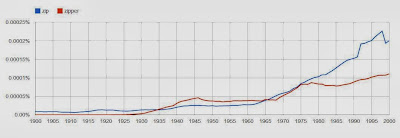
Zip has a lead even before the introduction of zipper, and never looks back. However, the frequencies on this graph are less than half those in US English
 It seems entirely reasonable, then, that Golding and Orwell would use zipper, although it reads strangely now.
She stood looking at him for an instant, then felt at the zipper of her overalls.1984
He laid a hand on the end of a zipper that extended down his chest.Lord of the Flies
As always, though, it pays to be careful with assumptions. The OED has the first use of zipper in 1925, when it was registered as a trademark, with use of the term claimed from 1923. Only shortly afterwards (1928) it was being used in the Daily Express. 1984 was written in 1948, of course, and Lord of the Flies in 1954.
The first use of "zip" as a noun in the OED is also from 1925.
The nearest approach to sustained bitterness that he was ever to know was caused by the sight of the women on the Avenue with their galoshes fastened by the ‘Zip’— every last one of them.E. O'Shaughnessy, Married Life
By an odd coincidence Eileen O'Shaughnessy was George Orwell's first wife. Subsequent uses are mainly British, including one from John Braine's Room at the Top from 1957. The Google ngram viewer results are as follows:
US English
Zipper takes an early lead, but is gradually overtaken by zip. I suspect this is largely because of other uses of "zip", ie as a verb, or to mean "nothing", etc

British English
Zip has a lead even before the introduction of zipper, and never looks back. However, the frequencies on this graph are less than half those in US English

Subscribe to:
Posts (Atom)